The Mood Hijack: Can Inflammation Affect Anxiety?
Anxiety can feel like it appears out of nowhere.
One moment you are fine, and the next your heart is racing, your thoughts are all over the place, you feel restless, or you can't settle. We usually think of anxiety as something that starts in the mind. Perhaps something is worrying us: a stressful situation, a difficult relationship, too much work, or an experience that has stayed with us.
But what if the story sometimes begins somewhere else; inside the body? One system that may be involved is the immune system. That may sound surprising. After all, what does inflammation have to do with feeling anxious? As it turns out, quite a bit. But before we get there, let’s talk about inflammation.
Inflammation is not always the enemy
We often hear the word inflammation and immediately think of something harmful. But inflammation is actually one of the body’s protective mechanisms. If you cut your finger, develop an infection or injure yourself, the immune system responds. It sends signals and brings the resources needed to deal with the problem and begin the healing process.
That’s acute inflammation, and we need it. The problem is when the body keeps receiving signals that something is wrong, even when there isn’t an obvious injury or infection to deal with. This can lead to low-grade, ongoing inflammation. Think of it like a fire alarm. When there is a fire, you want the alarm to go off. But you don’t want it ringing all day, every day, when there is no fire.
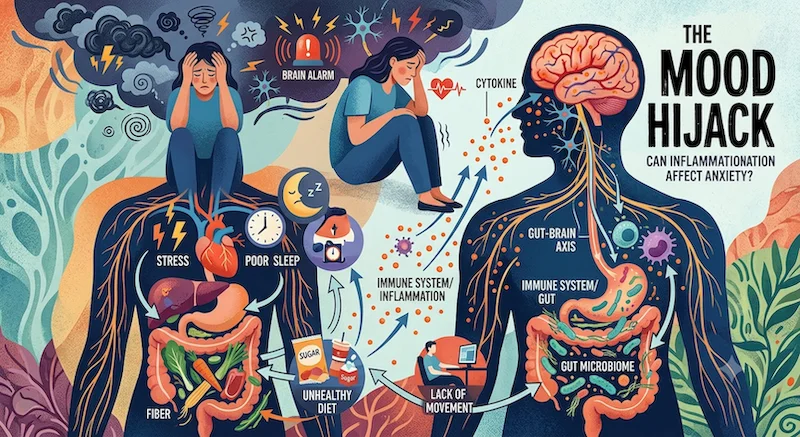
Modern life can sometimes keep the body’s alarm system working overtime. Poor sleep, prolonged stress, an unhealthy diet, lack of movement, certain illnesses, and other factors can all influence inflammatory processes in the body.
Your immune system and your brain are not two completely separate systems. They are constantly communicating. When the immune system is activated, it releases chemical messengers called cytokines. These are part of the body’s communication system during inflammation.
Some of these signals can influence the brain. Because the brain controls so much of how we think, feel, and respond to stress, changes in these signals may influence mood and emotional well-being. This doesn’t mean that inflammation causes anxiety. But it does suggest that what happens in the body can influence what happens in the brain.
When the body’s alarm meets the brain’s alarm
The brain already has an alarm system that helps us respond to danger. It lets you react quickly when something feels threatening.
That’s useful when there is a genuine danger. But when the body’s stress systems are repeatedly activated, that alarm system may become easier to trigger. You may find yourself feeling more on edge, more restless, more overwhelmed or less able to switch off.
For some people, inflammatory signals may be one factor influencing this response. Again, this is one piece of the puzzle, not the entire puzzle.
Anxiety has many possible contributors. Genetics, life experiences, trauma, relationships, stress, sleep, physical health and our environment can all play a role.
No single explanation fits everyone.
And then there is the gut.
You have probably heard about the **gut-brain connection.
It is not just a fashionable phrase.
The gut and brain communicate in several ways, and the trillions of microorganisms living in our gut (collectively known as the gut microbiome) are part of this conversation. The food we eat shapes the environment these microorganisms live in.
A diet rich in different plant foods provides fibre that supports a diverse gut microbiome. On the other hand, a diet dominated by highly processed foods and low in fibre may create a very different environment.
Researchers are still working out exactly how these changes influence inflammation, the nervous system and mental health. But we can say the gut, immune system, and brain are connected; and this is an area of research that is becoming increasingly interesting.
**The modern lifestyle can keep the cycle going
Think about how we live today.
We may sleep too little.
We may spend hours sitting.
We may eat irregularly or rely heavily on packaged and highly processed foods.
We may experience constant psychological stress.
We may spend much of the day indoors, surrounded by screens and notifications, with little time for the brain to truly switch off.
None of these automatically means that you have chronic inflammation. But together, these factors can place repeated demands on the systems that regulate stress, metabolism, immunity and mood. And sometimes a cycle develops.
**Stress affects sleep →Poor sleep affects energy and food choices → Changes in eating and activity affect how the body feels →Feeling physically depleted can make us less resilient to stress.
And the cycle continues.
The mind affects the body. The body affects the mind. It isn’t really possible to separate the two.
**So, what can we do about it?
No magical food switches inflammation off. And there is no single food responsible for your anxiety. Instead, look at your lifestyle patterns.
- Are you eating enough vegetables, fruits, pulses, whole grains, nuts and seeds?
- Are you getting enough fibre?
- Are you including sources of healthy fats, including omega-3 fats?
- Are your meals reasonably balanced, rather than being built mainly around refined carbohydrates?
- Are you sleeping enough?
- Are you moving your body regularly?
And perhaps most importantly, when was the last time your nervous system got a chance to slow down?
Sometimes the answer isn’t another supplement, another food rule or another health hack.
Sometimes it is a walk. A proper night’s sleep. A few minutes of slow breathing. Time outdoors. A meal eaten without rushing. A little less screen time. Or simply recognising that your body has been under pressure for longer than you realised.
This is not about blaming your body
If you experience anxiety, I would not want you to read this and conclude that your anxiety is “because of inflammation” or that you should be able to fix it by changing your diet.
That would miss the point completely.
Anxiety is real, and it can be complicated.
For some people, psychological support or medical treatment is an important part of managing it. Nutrition and lifestyle cannot replace that.
What we are beginning to understand is something slightly different:
The brain does not exist in isolation from the rest of the body.
What happens in the immune system, the gut, our stress response, our sleep and our metabolism can all send signals to the brain. Inflammation may be one of those signals. And perhaps this gives us a more useful way of looking at mental wellbeing; not as something that is “all in your head,” but as something that involves the whole person.
We still don’t know much.
But the more we understand about the conversation between the immune system and the brain, the clearer it becomes that taking care of one can sometimes mean taking better care of the other.
*In the next article, we will look more closely at this conversation between the immune system and the brain and why stress, sleep and our everyday environment may influence it.

Shruti Marjara Kushwaha
Nutritionist & Founder, NutriMantra
Shruti blends evidence-based nutrition with practical Indian food guidance, shaped by experience across AIIMS, VLCC, HealthKart, research, counselling, and long-term lifestyle support.
Dealing with bloating, sluggish digestion, or a sensitive gut?
A personalised consultation can help you identify practical food patterns, fibre balance, and meal structures that feel better.
Learn with Shruti


Related Articles

The Anti-Inflammatory Power of Turmeric, Ginger, and Garlic
In a world where lifestyle diseases are rising and chronic inflammation is quietly wreaking havoc on our bodies, your kitchen may hold some of the most powerfu…
Read article →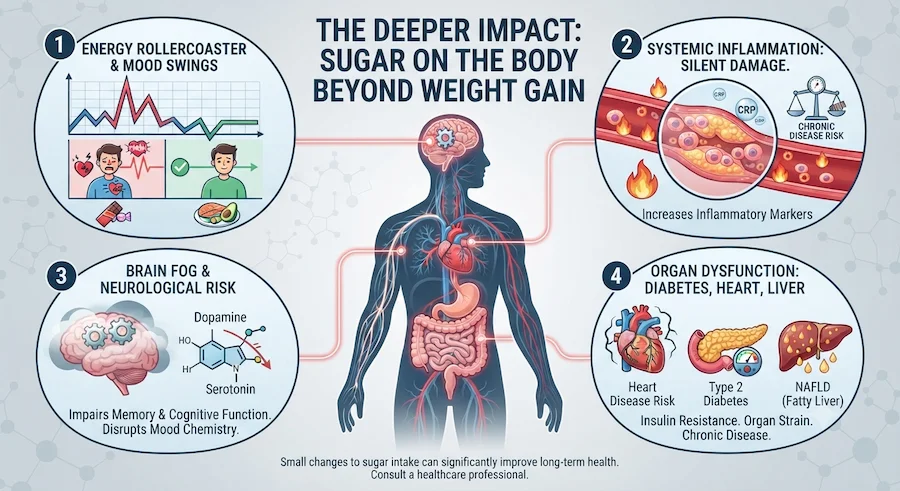
The Impact of Sugar on Your Body: Beyond Weight Gain
Cutting added sugar can smooth energy swings and help brain clarity; in India, swap sweetened coffee and juices for fruit, protein, and fiber.
Read article →
What Happens to Your Gut Health When You Eat More Protein
Protein has become the darling of the nutrition world, from shakes to high-protein diets promising weight loss and boundless energy.
Read article →
Comments (0)
No comments yet. Be the first to share your thoughts.
Leave a Comment
Your comment will appear after moderation.