
Why Am I Always So Tired? Let's Talk About It

We have all been there. The alarm goes off, and instead of feeling refreshed and ready to take on the day, you are already negotiating with yourself — just five more minutes. You drag yourself out of bed, and by mid-morning, you are running on coffee and willpower alone. Sound familiar?
A rough morning isn't just about feeling groggy, it is about feling unwell. When fatigue becomes a daily companion, it quietly erodes your mood, focus, and relationships. You show up to work, but you are not really there. You come home, but you don't have much left to give. And the worst part? You can't always explain why.
The good news is that persistent tiredness rarely comes without a reason. More often than not, your body is trying to tell you something. Let's listen.
You are Probably not sleeping as well as you Think
Most of us know we need around 7 to 8 hours of sleep, but how many of us are actually getting quality sleep? There is a big difference between lying in bed for eight hours and truly resting. Stress, irregular schedules, and conditions like sleep apnoea (where breathing briefly stops during sleep, jolting your body out of deep rest without you even realising it ), can all leave you waking up more exhausted than when you went to bed.
Start small: Try going to bed and waking up at the same time every day, even on weekends. It sounds almost too simple, but a consistent sleep rhythm can make a remarkable difference. And if you find yourself staring at the ceiling night after night despite your best efforts, it is worth having a conversation with your doctor.
Are You Drinking Enough Water?
Think about the last time you spent a long afternoon in the sun or pushed through a stomach bug. Remember that bone-deep exhaustion that followed? That is dehydration at work. Even mild fluid loss can sap your energy levels surprisingly quickly.
Staying hydrated doesn't have to be complicated. Sip water consistently throughout the day rather than trying to gulp it all down at once. Bear in mind that your needs will vary — your activity level, the climate you live in, and even the foods you eat all play a role. Water-rich fruits and vegetables count too. The goal is simply to make hydration a habit, not a chore.
Your Body Needs Fuel — Real Fuel
Imagine trying to drive a car with an almost empty tank. You might make it a few miles, but eventually, you will sputter to a halt. Our bodies aren't so different. When we skimp on calories, whether through restrictive dieting, skipping meals, or simply not eating enough of the right things, we are essentially running on fumes.
Your brain, in particular, is an energy-hungry organ. It demands a steady supply of glucose to keep you sharp, focused, and emotionally balanced. When that supply dips, everything suffers: your concentration, patience, productivity. Eating regular, balanced meals isn't indulgence; it is maintenance.
Sometimes, Tiredness Is a Message Worth Decoding
Here is something that often gets overlooked: persistent fatigue can sometimes be a quiet symptom of something happening beneath the surface. Conditions like hypothyroidism, diabetes, anaemia, urinary tract infections, depression, and even certain cancers can all manifest as chronic tiredness long before other obvious symptoms appear.
This isn't meant to alarm you; it is meant to empower you. If you have been tired for weeks and can't pinpoint why, please don't brush it off as "just stress." A simple visit to your doctor and a few routine tests can either put your mind at ease or catch something early when it is most treatable.
What You Eat Matters More Than You Might Realise
Even if you are eating enough, what you are eating matters enormously when it comes to energy. Your cells depend on specific vitamins and minerals to convert food into usable fuel, and many of us are quietly running low without even knowing it.
B vitamins are the workhorses of energy metabolism; without adequate levels, your cells simply can't do their job efficiently. Magnesium plays a similar supporting role, yet it is one of the most commonly deficient minerals in adults. And then there's the group of nutrients — iron, folic acid, vitamin B12, zinc, and vitamin C — that work together to keep your blood healthy. When your blood isn't carrying oxygen effectively, fatigue and breathlessness follow almost inevitably.
The reassuring thing is that these deficiencies are identifiable and treatable. A doctor or nutritionist can run tests, pinpoint what is missing, and recommend dietary changes or supplements to get you back on track.
You Deserve to Feel Good in the Morning
Chronic tiredness has a way of making you feel like this is just how life is now — like exhaustion is your new normal. It isn't, and it doesn't have to be.Your energy is worth fighting for. Not just for the sake of productivity or ticking things off a to-do list, but because feeling well is what allows you to be fully present — for your work, for the people you love, and for yourself. Start by paying attention to what your body is telling you, make the small changes where you can, and don't hesitate to seek help when you need it.
Better mornings are possible. You just have to give your body the chance to show you.

Shruti Marjara Kushwaha
Nutritionist & Founder, NutriMantra
Shruti blends evidence-based nutrition with practical Indian food guidance, shaped by experience across AIIMS, VLCC, HealthKart, research, counselling, and long-term lifestyle support.
Long workdays, erratic meals, and low energy can snowball quickly.
Get a nutrition plan built for busy schedules, low-step days, snack habits, and sustainable energy.
Frequently Asked Questions
Why am I always tired even after sleeping 8 hours?
What are some Indian foods that can help boost my energy levels?
How much water should I drink daily in the Indian climate?
Is it true that skipping meals can lead to more fatigue?
Learn with Shruti



Related Articles

Myths and Facts on Water and Hydration
Water is the most undervalued nutrient by humans. Its importance can be ascertained by the fact that scientists search for existence of life only on those plan…
Read article →
Are You Cooking the Nutrition Out of Your Food?
Cooking doesn’t automatically drain nutrition. Use less water, avoid overcooking, and remember that dal, sambar and curries retain nutrients in their cooking liquid.
Read article →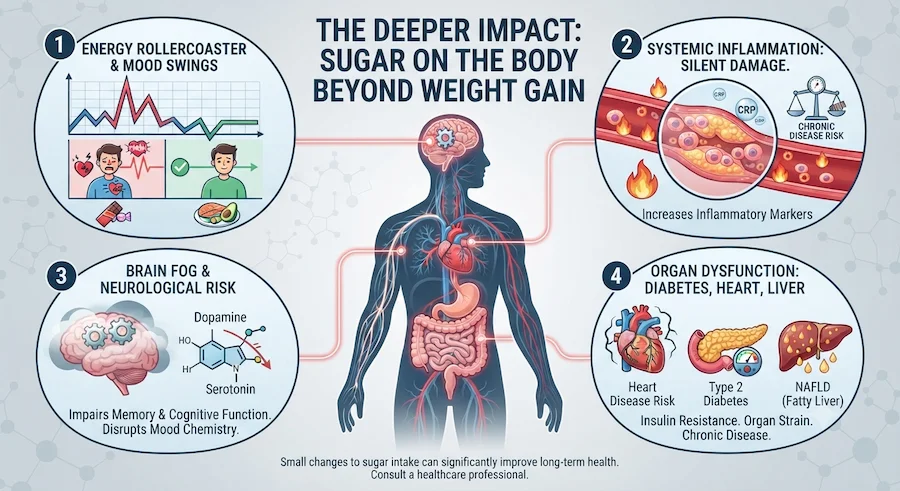
The Impact of Sugar on Your Body: Beyond Weight Gain
Cutting added sugar can smooth energy swings and help brain clarity; in India, swap sweetened coffee and juices for fruit, protein, and fiber.
Read article →
Comments (0)
No comments yet. Be the first to share your thoughts.
Leave a Comment
Your comment will appear after moderation.